
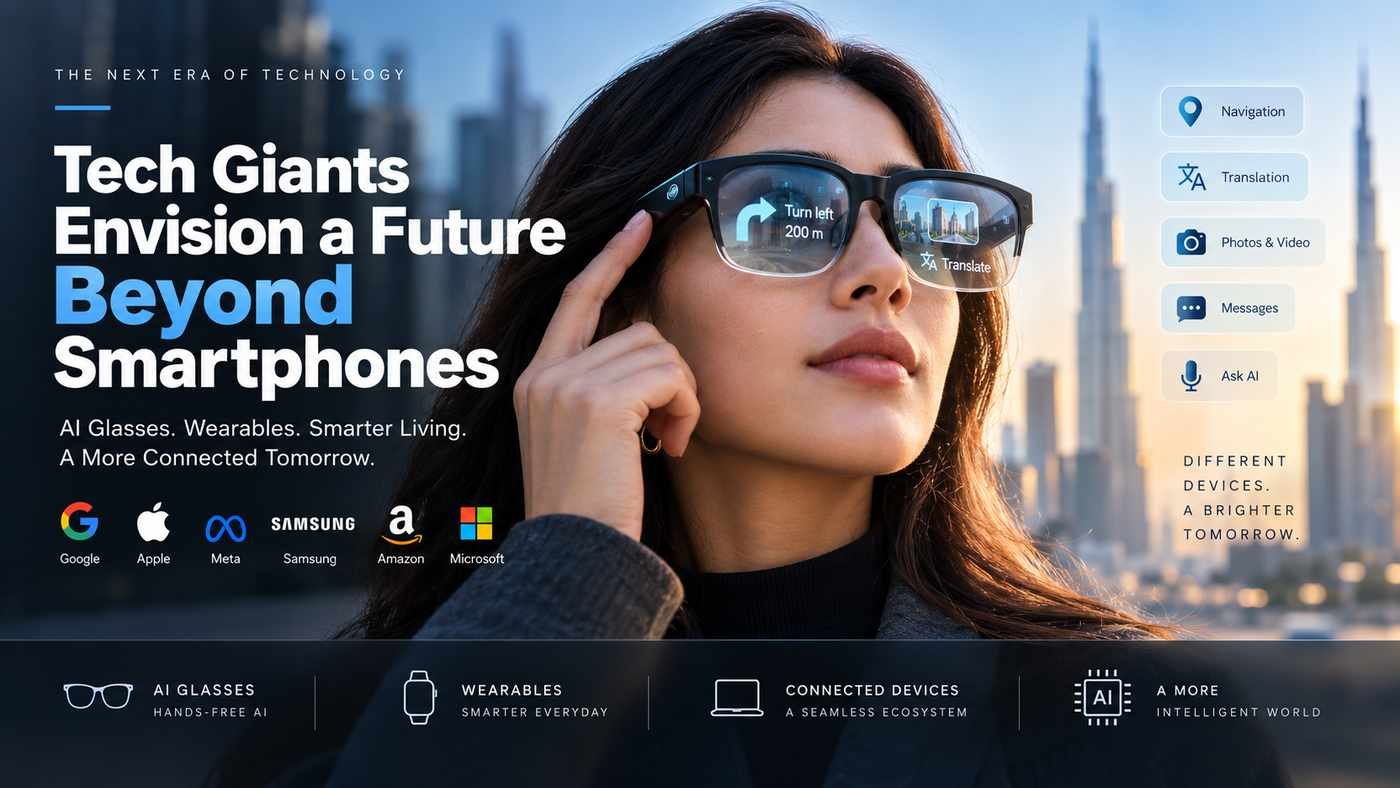

Tech giants envisioning a future beyond smartphones are developing new ways to access computing, AI and digital information without relying on a phone screen for every task.
The clearest example is the rise of AI-powered glasses.
Google is building Android XR around glasses and headsets with Gemini. Meta is expanding its AI-glasses range. Samsung describes intelligent eyewear as a new interface for mobile AI, while Qualcomm is developing chips that can run AI directly on glasses.
This does not mean smartphones are about to disappear.
Instead, technology companies are moving toward a model where computing is spread across several devices. A smartphone may remain important while glasses, watches, earbuds and AI assistants handle more everyday interactions.
Why Tech Giants Are Looking Beyond the Smartphone
The smartphone remains one of the most capable personal computers people carry.
It has a large display, cameras, powerful processors, sensors, wireless connectivity and access to millions of applications.
But using a phone usually requires attention.
You have to take it out, look at the screen, unlock it and interact with an app.
AI-powered wearables offer another model.
A person could ask an assistant a question through glasses, receive directions while walking, translate a conversation or capture a photograph without reaching for a phone.
Google’s Android XR glasses strategy already focuses on this type of hands-free interaction, including directions, text messages and photos.
The change is therefore not simply about replacing a piece of hardware.
It is about changing how people interact with computers.
AI Is Changing the User Interface
Traditional computing relies heavily on screens, keyboards and touchscreens.
AI introduces additional ways to interact:
- Voice
- Natural language
- Images
- Video
- Gestures
- Context
- Environmental information
An AI assistant can potentially understand what a user is looking at and respond to a spoken request.
That makes glasses particularly interesting because they sit directly in front of the user’s eyes and near their ears.
Computing Is Becoming More Distributed
Instead of one device doing everything, different devices can handle different tasks.
| Device | Potential role |
|---|---|
| Smartphone | Apps, large-screen tasks, communication and general computing |
| AI glasses | Hands-free AI, visual information and quick assistance |
| Smartwatch | Notifications, activity and quick controls |
| Earbuds | Audio, calls and voice interaction |
| XR headset | Immersive work, entertainment and spatial computing |
| Laptop | Productivity and demanding tasks |
Qualcomm itself describes a future in which smart glasses can work independently while also working alongside smartphones, PCs, watches and other wearable sensors.
AI Glasses Are Leading the Shift
AI glasses are attracting attention because they combine several useful technologies in a familiar form.
A pair of smart glasses can potentially contain:
- Cameras
- Microphones
- Speakers
- Wireless connectivity
- AI processing
- Sensors
- Displays
The exact combination depends on the product.
Some glasses have no display and rely on audio. Others add visual information directly in the user’s field of view.
Google and Android XR
Google’s Android XR platform is being developed with Samsung and Qualcomm for headsets and glasses.
Google says its intelligent eyewear will come in two forms: audio glasses and display glasses. Gemini can provide assistance while users remain hands-free. Demonstrated functions include directions, messaging and photography.
Google’s approach is significant because the company is not treating glasses as an isolated gadget.
Android XR is intended to connect an ecosystem of applications, AI and hardware.
Meta and AI Glasses
Meta has made AI glasses a major hardware focus.
Its Meta Glasses line combines eyewear with Meta AI, cameras, microphones and speakers. Meta says its latest products can provide AI assistance, understand what the wearer is seeing and support hands-free activities.
Meta has also expanded its range to prescription-focused products and different styles, making everyday wearability a major part of its strategy.
The company is also working on display-equipped glasses.
That creates an important distinction:
Smart glasses can provide AI assistance without a display, while AR glasses can add digital information to the user’s view.
Samsung Intelligent Eyewear
Samsung introduced its intelligent eyewear in 2026 and described the product as an important step toward making AI glasses a new interface for mobile AI.
Samsung’s own explanation is especially relevant to the smartphone question. The company says the goal is not to replace the mobile phone, but to extend mobile experiences beyond the screen.
That makes Samsung’s position a useful reminder that “beyond smartphones” does not necessarily mean “without smartphones.”
Qualcomm and On-Device AI
The processor is one of the less visible but most important parts of this transition.
Qualcomm demonstrated generative AI running directly on smart glasses using its Snapdragon AR1+ platform. The demonstration did not require a phone or cloud connection for the AI interaction.
On-device processing could provide several advantages:
- Lower dependence on cloud services
- Potentially lower latency
- Greater independence
- Better responsiveness
- More private processing for some tasks
However, not every AI function can or will necessarily run locally. More demanding workloads may still require a smartphone or cloud infrastructure.
How AI Glasses Could Reduce Smartphone Use
AI glasses do not need to perform every smartphone function to make a difference.
They only need to make certain everyday tasks easier.
Navigation
Navigation is an obvious use case.
Instead of repeatedly looking down at a phone, users could receive spoken directions or, with display-equipped glasses, visual navigation information.
Google has specifically demonstrated navigation features for its Android XR glasses.
Translation
AI glasses can combine microphones, cameras and AI translation.
A user could hear a translated conversation or receive help understanding text in another language.
This is especially useful while travelling because it reduces the need to switch constantly between the environment and a phone screen.
Messaging and Calls
Voice interaction can make simple communication less dependent on a touchscreen.
Users could potentially dictate messages, listen to incoming messages or start calls through their wearable.
The advantage is not that typing on a phone becomes impossible.
It is that many short interactions no longer require taking the phone out.
Visual AI
A camera-equipped pair of glasses can capture information from the user’s point of view.
AI can then potentially help answer questions about that environment.
Examples include:
- Reading a sign
- Identifying an object
- Explaining something visible
- Recognising a landmark
- Providing contextual information
- Helping with everyday tasks
This is where multimodal AI becomes particularly important.
The system is no longer working only with text. It can combine visual and audio information with a user’s spoken request.
Photography and Video
AI glasses can also act as hands-free cameras.
Meta’s AI glasses already support hands-free photo and video capture, alongside Meta AI features.
For some situations, this can be more natural than pulling out a phone.
Why Smartphones Are Not Disappearing Yet
The smartphone still has major advantages.
A large touchscreen is better for many complex tasks.
Editing a detailed video, managing spreadsheets, shopping online or working with several applications is difficult on ordinary glasses.
Smartphones also have mature operating systems, huge app ecosystems and relatively large batteries compared with small wearable devices.
| Area | Smartphone | AI Glasses |
|---|---|---|
| Display | Large | Small or absent depending on model |
| Input | Touch, keyboard, voice | Voice, gestures and other inputs |
| Camera | Mature multi-camera systems | Compact cameras |
| Battery capacity | Larger | Limited by frame size |
| Portability | Pocket device | Wearable |
| Hands-free use | Limited | Major advantage |
| Complex tasks | Strong | More limited |
| Privacy concerns | Familiar | Cameras and microphones raise additional concerns |
The likely transition is therefore gradual.
People may use glasses for quick tasks and their phone for more demanding ones.
Battery and Power
Battery capacity is a major limitation.
Glasses need to remain lightweight and comfortable. That restricts how much battery and processing hardware can fit inside the frame.
Running cameras, wireless connections, displays and AI processing can increase power consumption.
Qualcomm specifically highlights the difficulty of building powerful computing systems into small, battery-constrained glasses.
Connectivity
Some wearable features can work locally, but other tasks may need a phone or internet connection.
That means connectivity remains important.
A future pair of glasses may therefore operate as a standalone computer for some tasks while still communicating with other devices for more demanding workloads.
Displays and Input
Putting useful information in front of the user’s eyes is technically challenging.
The display must be:
- Small
- Bright enough
- Power efficient
- Comfortable
- Safe to use
- Easy to read
AR glasses add another challenge: digital objects need to appear naturally within the real environment.
Privacy
Privacy could become one of the biggest barriers to widespread adoption.
A wearable camera can potentially capture people who did not agree to be recorded.
Meta has built privacy features around its AI glasses, including a capture indicator.
The issue is serious enough that Reuters reported in September 2026 that Meta was preparing a camera-free smart-glasses model amid growing privacy concerns surrounding camera-equipped wearables.
This shows that technical capability alone will not determine the future of AI glasses.
Public trust will matter too.
Cost and Social Acceptance
A device also needs to be comfortable enough for everyday use.
People already wear prescription glasses and sunglasses, which gives smart glasses a natural advantage over bulky headsets.
Samsung has also emphasised wearability as a critical engineering requirement for AI glasses.
AI Hardware Is Moving Beyond Consumer Phones
The post-smartphone shift is not limited to entertainment or personal communication.
Amazon’s Workplace Smart Glasses
Amazon is developing smart glasses for delivery workers.
The system is designed to help drivers with tasks such as package scanning, navigation, hazard awareness and proof of delivery without repeatedly relying on a smartphone.
This is an important example because the value is practical.
The glasses can put relevant information closer to the worker while keeping their hands available.
Similar principles could eventually apply to areas such as:
- Logistics
- Warehousing
- Manufacturing
- Maintenance
- Field services
- Training
- Healthcare
The exact applications will depend on the hardware, software and regulatory environment.
Apple’s AI Ecosystem
Apple is taking a broader ecosystem approach to AI.
In September 2026, Apple released its next generation of Apple Intelligence and began rolling out its new Siri AI experience. Apple says Siri AI can use personal context, onscreen awareness and systemwide app actions across its products.
This matters to the post-smartphone story because AI does not have to arrive through a new physical device first.
The interface can evolve within an existing ecosystem.
Apple’s approach shows another possible route:
Make existing devices increasingly intelligent before introducing entirely new categories.
OpenAI and New Hardware
OpenAI is also exploring hardware.
OpenAI announced that the io Products team associated with Jony Ive had merged with OpenAI. The company said the group would work on new products and new ways of interacting with technology.
OpenAI has not established a consumer product that can currently be described as a smartphone replacement.
What matters is the direction: AI companies are increasingly thinking about the hardware interface itself, rather than treating AI as software that always lives inside an existing phone or computer.
What Early AI Devices Can Teach the Industry
The first wave of standalone AI gadgets showed that creating a new interface is difficult.
A product can have an interesting AI assistant and still fail to offer enough practical value to replace established smartphone habits.
This creates an important test for future devices:
Does the new device solve everyday problems more naturally than the phone?
AI glasses have a potential advantage because they occupy a useful physical position.
They can see what the user sees, hear what the user hears and provide audio or visual feedback without requiring the user to hold a device.
But that advantage must be balanced against privacy, battery life, comfort and cost.
What the Post-Smartphone Future Could Look Like
The most realistic future is likely to involve several connected devices rather than one smartphone replacement.
A typical personal technology setup could eventually include:
- AI glasses for visual information and hands-free assistance
- Earbuds for audio and conversations
- A smartwatch for quick alerts and controls
- A smartphone for complex apps and larger-screen tasks
- A laptop for work and productivity
- AI agents connecting the different devices
This creates a distributed computing model.
The user does not always have to decide which application to open.
Instead, an AI assistant can become a layer connecting the person with the services they need.
That could make technology feel less like a collection of separate apps and more like an intelligent computing environment.
The smartphone would still have an important role, especially for demanding tasks.
But it may no longer need to be the device people look at every few minutes.
Conclusion
The future beyond smartphones is already taking shape, but it is not simply a story about one device replacing another.
Google is developing Android XR and Gemini-powered eyewear. Meta is expanding AI glasses and experimenting with new form factors. Samsung sees intelligent eyewear as an extension of mobile AI. Qualcomm is developing hardware capable of running AI directly on glasses. Amazon is exploring wearable computing for delivery work, while Apple and OpenAI are expanding their approaches to AI interfaces.
The more credible direction is therefore not “the smartphone is dead.”
It is a shift from one central screen toward a connected collection of devices.
AI glasses may handle quick visual and voice interactions. Watches can provide instant information. Earbuds can become AI interfaces. Smartphones can remain the main device for complex tasks.
In this model, the biggest change is not the disappearance of the smartphone.
It is the possibility that people will need to look at their phones less often.
Frequently Asked Questions
Are tech companies trying to replace smartphones?
Some companies are developing devices that can reduce dependence on smartphones, but there is no established industry-wide replacement. Samsung, for example, explicitly describes its intelligent eyewear as an extension of mobile experiences rather than a replacement for the phone.
Are AI glasses the future of smartphones?
AI glasses are one of the strongest emerging alternatives for certain smartphone interactions, but it is too early to say they will completely replace phones. Google, Meta, Samsung and Qualcomm are all developing the category.
Can AI glasses work without a phone?
Some can perform AI processing directly on the glasses. Qualcomm has demonstrated generative AI running directly on smart glasses without a phone or cloud connection. However, capabilities vary by device, and other functions may still rely on a connected phone or network.
What is Android XR?
Android XR is Google’s platform for extended-reality devices, including headsets and glasses. Google is developing it with partners including Samsung and Qualcomm, with Gemini providing AI assistance across compatible experiences.
What is the difference between AI glasses and AR glasses?
AI glasses focus on functions such as voice assistance, cameras, audio and AI. AR glasses can also place digital information directly into the user’s field of view. Some future products may combine both categories.
Why are companies putting AI into glasses?
Glasses can provide hands-free access to cameras, microphones, speakers and, in some products, displays. This gives AI access to information from the user’s surroundings while reducing the need to look at a phone.
Will smartphones disappear?
There is currently no reliable timetable for smartphones disappearing. The stronger evidence points toward smartphones becoming one component of a broader personal-computing ecosystem.
What is the biggest challenge for AI glasses?
There is no single challenge. Battery life, comfort, privacy, heat, connectivity, display technology, cost and social acceptance all need to be solved for AI glasses to become a mainstream everyday platform.
